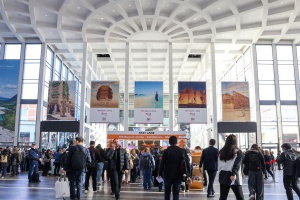
As the doors open this week at Messe Berlin, the familiar early‑March ritual returns: thousands of travel professionals converging on the German capital for ITB Berlin, the world’s leading travel trade show. This year’s edition feels especially charged. ITB Berlin 2026 not only marks the fair’s 60th anniversary, but arrives at a moment when global travel is buoyant yet uneasy—growing strongly, while navigating geopolitical tension, technological disruption and a renewed debate about tourism’s role in the world.
For three days, from 3–5 March, Berlin becomes a microcosm of the travel industry at large: hopeful, innovative and pragmatic in equal measure.
Breaking Travel News and its team will be there across all three days covering the latest stories as they happen and conducting live interviews across every sector.
A Milestone Moment for Global Tourism
Few events can claim the gravitational pull of ITB Berlin. What began in 1966 as a modest gathering of exhibitors has grown into the industry’s most influential B2B marketplace, bringing together destinations, airlines, hotels, tour operators, technology providers and policymakers from every corner of the globe.
The 2026 edition is an anniversary show in every sense. The official host country, Angola, takes centre stage, using the platform to present itself as one of Africa’s next emerging destinations—rich in culture, dramatic landscapes and long‑term tourism ambition. Across the halls, established tourism powerhouses sit alongside newcomers, reinforcing ITB’s unique role as a level playing field where mature markets and rising stars share the same spotlight.
But this is not a nostalgic celebration. The dominant mood is forward‑looking. Travel has rebounded to near pre‑pandemic levels, business travel and MICE are firmly back, and demand for holidays remains resilient. At the same time, the industry is acutely aware that growth alone is no longer the metric that matters.
What Visitors Can Expect This Year
The show floor reflects an industry in transition. Visitors can expect:
A sharper focus on balance and responsibility
Running alongside the exhibition, the ITB Berlin Convention sets the intellectual tone. Under the headline theme “Leading Tourism into Balance,” more than 400 speakers explore how destinations and businesses can reconcile growth with climate responsibility, community impact and long‑term resilience. Overtourism, biodiversity, climate adaptation and social inclusion are no longer fringe topics—they are central to the conversation.
Technology that’s moved beyond buzzwords
Artificial intelligence is everywhere at ITB this year, but the discussion has matured. Rather than abstract hype, sessions and stands focus on practical applications: smarter demand forecasting, AI‑driven customer service, personalised marketing and operational efficiency. The question is no longer if AI will reshape travel, but how to deploy it responsibly and inclusively.
A re‑energised business travel and MICE sector
Corporate travel, events and incentives have staged a strong comeback, and ITB reflects that momentum. Expect packed forums on hybrid events, risk management, duty of care and the evolving expectations of business travellers who increasingly blend work with leisure.
New voices and emerging destinations
From Africa and Latin America to parts of Asia, emerging destinations are more visible than ever. Many are using ITB not just to sell holidays, but to court investment, airlines and long‑term partnerships—signalling a shift from volume‑driven tourism to strategic development.
ADVERTISEMENT
Anniversary energy
Special exhibitions, guided tours and evening events underline ITB’s 60‑year legacy. There’s a celebratory air after hours, but the conversations over coffee remain firmly rooted in the future.
The Shadow Over the Show: Middle East Conflict
No global travel gathering exists in isolation from world events, and this year ITB Berlin unfolds against the backdrop of escalating conflict in the Middle East. The region is not only a major destination market, but a critical hub of global aviation. Airspace disruptions, flight rerouting and heightened security concerns have rippled through airline networks connecting Europe, Asia, Africa and beyond.
The immediate impact on ITB is nuanced rather than dramatic. The show is fully booked, and overall attendance remains strong. However, there is a noticeable shift in how some participants are attending. A small number of delegations have faced travel delays or last‑minute route changes, and contingency planning is a recurring topic in corridors and conference halls. Hybrid meetings, remote participation and flexible scheduling—skills honed during the pandemic—are once again proving their value.
More importantly, the conflict is shaping the content of ITB rather than undermining it. Geopolitics, aviation resilience and crisis preparedness feature prominently in conference sessions. Tourism leaders are openly discussing how dependent the industry has become on stable global connectivity—and how vulnerable it is when that stability fractures.
There is also a deeper, philosophical undercurrent. Tourism has long been described as a “business of peace,” built on exchange, understanding and movement. At ITB this year, that idea feels less like a slogan and more like a challenge. How can travel foster dialogue and economic opportunity in a world marked by division? How does the industry remain open while keeping people safe?
Why ITB Berlin Still Matters
In uncertain times, the instinct might be to retreat. ITB Berlin does the opposite. Its value lies precisely in bringing the industry together when circumstances are complex. Deals are still done, routes still planned, campaigns still launched—but they are informed by a more realistic view of risk and responsibility.
For first‑time visitors, ITB 2026 offers a sweeping overview of where travel is heading. For veterans, it provides reassurance that the industry has learned to adapt—again. And for Berlin, it is another week when the world arrives with suitcases, business cards and big ideas.
As the travel industry looks beyond recovery toward reinvention, ITB Berlin this week is less a trade show than a mirror. What it reflects is an industry that is growing, questioning itself, and learning—once more—to navigate a complicated world while keeping the spirit of travel alive.